History of the Bradford Chess Club 1853 - 1953
Part
1 of 4
Click here to download Part 1 in PDF
Click here to download Part 2 in PDF
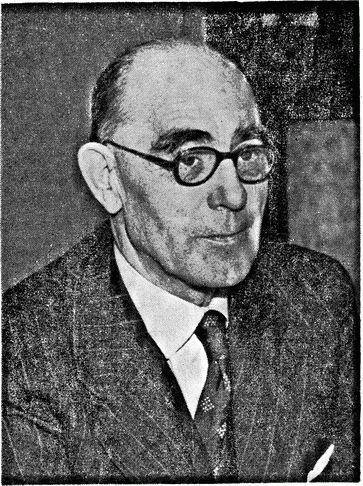
BY THE PRESIDENT
Those of us who are members of the Bradford
Chess Club, living in this its Centenary Year, pause for
a while to contemplate the remarkable fact that this club, formed
by a few enthusiastic lovers of the game of chess on a winter's evening
in November, 1853, has continued
an unbroken course for a hundred years. There is a very natural desire amongst
the present members of the club to mark this memorable record.
This desire is prompted partly by a love for the game, partly by
a feeling of pride in the club and partly by a respect for those who
at different times in the last hundred years have constituted The Bradford
Chess Club. I myself cast my mind back in Bradford
chess circles some thirty years. Many well known names of this period
leap to my mind. I recall them with respect; some indeed
with affection. I refrain, however, from mentioning their
names; for were I to do so I should almost certainly omit some
by inadvertence, and in any case the list would be only a personal
one.
My reflections upon the game of chess
as it is played in Bradford circles impress upon me the fact that
to some players this King of Games is a very serious matter-almost
a way of life; yet to the great majority of players, it is fortunately
still just a game, as may be
witnessed by any interested observer who cares to visit the club's
headquarters
at the Bradford Central Cafe any day during a lunch hour. For here, at this time of day, chess
is played with an air of abandon, untrammelled by convention or orthodoxy. The
players follow
their own whims and fancies, exploring the whole 64 squares of
the chess board as expectantly as Captain Cook explored the
uncharted Pacific Seas, putting in here and pulling out there, now
meeting
with disaster and now with success, yet ever moving with high adventure and commendable endeavour.
Since the end of the Second World War,
the record of the Bradford Chess Club in competitive chess has been
a creditable one, as a glance at the official records will show.
Whilst the club's teams have always included a majority of seasoned
and experienced players, some indeed whose reputations
have passed beyond local boundaries, the club has been fortunate in having
a constant infusion of youth. It has pursued the policy of encouraging
young players. It is no accident that during this Centenary
Year the club's first and second ranking players are aged 21 and 18 respectively
and are both still pursuing their educational studies. Playing on the first and second boards during the present season, these
two young players have engaged the very cream of Yorkshire chess
and have more than held their own.
It is a considerable source of gratification
to me as I am 'sure it is also to all present members of the
Bradford Chess Club, that to mark the occasion of the club's Centenary,
Mr. Charles H. Leach, assistant editor of the "Telegraph
and Argus", has written a history of the club in the pages which follow
this foreword. No one
is more competent
than Mr. Leach to undertake this work. He
is not only a
lover of chess but also a very worthy exponent of the art. He has
always
taken a great interest in the club. For
some years he played with the first team and for three years
1938-39,
1939-40 and 1945-46 - he was the club's secretary.
I express with confidence the hope and
belief that this little book relating the history of the Bradford Chess
Club will prove to be of interest and value to lovers of chess not
only in Bradford and district, but also wherever the game of
chess is played.
23rd April, 1953, GEORGE R. LAWSON, President.
HISTORY OF THE BRADFORD
CHESS CLUB
On 8th November, 1853, fifteen professional
and business men, all of them well known in Bradford, met
in the ante-room" of the Exchange and, say the minutes of the meeting,
decided "that a club be now formed to be called the Bradford
Chess Club".
Who was primarily responsible for the
calling of the meeting I have been unable to discover. It is merely recorded that it was convened by circular. Probably it resulted
from discussions by men who met at the Exchange and who, inspired
by the fact that England had become the chess centre of the world
and that a number of cities and towns in Yorkshire had formed
clubs, felt that it was time Bradford did likewise.
It is surprising indeed that the club
was not formed many years earlier. In January, 1841, the Yorkshire
Chess Association, the first of its kind in the country, was
formed at Leeds, and before the Bradford club came into being the
association had held meetings at Halifax, Huddersfield, Hull, Leeds
and
Wakefield. In 1852 the association extended its area and
changed its
title to "The Northern and Midland Counties Chess
Association", and this ultimately led to the formation of the
British Chess Association.
Yorkshire, and particularly the West Riding,
was therefore a pioneer in the organisation of chess activity, and the founders of the Bradford club did not lack encouragement.
Some of them no doubt had also been inspired by reports
of the feats of the brilliant Howard Staunton, the first recognised
champion of the world, and by descriptions of the first great international
tournament, which had been held in this country in 1851.
Probably copies of Staunton's comprehensive volume "The Chess-player's
Handbook" had by that time reached Bradford, his "maxims
and advice" had been absorbed, and his detailed analyses of
the openings given great study.
How impressed they must have been by the
opening sentence in Staunton's preface, which said: "Wide as is the field of theory which
comprehends the manifold varieties of openings and endings in the
game of chess, its every part has been explored in modern times with
so much skill and perseverance that little now remains for a follower
in this walk beyond the adaptation and arrangement of materials which have
been garnered by his predecessors."
The mysteries of the game had been plumbed
to the depths! All that was required was study and practice.
To
the fifteen men who first provided Bradford chess players
with
the opportunity for practice we are indebted.. The club they formed has without interruption continued for a century. It
has had its ups and downs. Once during its early years a member did
propose that, owing to lack of enthusiasm and poor attendance,
it should cease, but its enthusiasts
rejected his advice. They had confidence in its future and
in spite of many more periods of depression that confidence has
been justified. While clubs have come and gone and some have suspended
activities and then re-formed the Bradford Chess Club has
continued in operation, and is one of the most notable in the country.
It has celebrated its centenary year by
winning the Yorkshire championship-the Woodhouse Cup-a trophy
it has held on 19 occasions. It has numbered among its members
two British champions, and it has provided the county
with many of its finest players.
The founders of the club were men of enthusiasm.
The first minute book itself shows that
they considered they were forming a club of some permanence. It is a large,
leather-bound volume with the title "Bradford Chess Club, Minute
Book" printed in handsome gilt letters on the cover, and of such
excellent quality that today it remains in perfect preservation and almost
as plain to read as when the minutes were first written on its
pages.
Before the close of the centenary year
the book will be honoured by being given a place in the archives
of Bradford's Central Library, where it will be well preserved and available,
I suppose, for the writer of the bi-centenary booklet in
2053-for who would doubt that this vigorous club will continue long
after its centenary is forgotten?
Those present at the first meeting were
Mr. W. B. Addison, Dr. Bennett, Mr. Benjamin Broughton, Mr. George
Gorrell, Mr. W. H. Greaves, Mr. A. Harris, jun. (who was
appointed a vice-president), Mr. J. A. Heselton (who was appointed
secretary-and an admirable secretary he was if his detailed and expressive
minutes are a guide), Mr. Gilbert Keighley, Mr. Samuel Laycock
(the first president), Mr. George Oxley, Mr. Robert Milligan,
jun. (the first treasurer), Mr. George Nesbit, Mr. W. T. Outhwaite,
Mr. J. C. Ramsden, and Mr. David Ramsden. Mr. Julius Schlesinger,
who was appointed a vice-president, was not present.
After electing the officers the meeting
was occupied for the rest of the time in preparing the rules, and
the following week these were adopted and a copy
was provided for each member. Whether they were printed or whether the secretary
had to write them out is not stated. He certainly entered them neatly in the
minute book, and today they can be read as easily as any other minutes
that have been recorded during the club's history-and much more
easily than some.
Club nights were fixed for one evening
per week-Tuesday-from 1st October to 1st April, and the hours
were 7 p.m. to 1 p.m. The entrance fee was lOs., and the annual
subscription lOs., which in those days was expensive, and much higher
in money value than today's annual subscription of £1
Ss. Although the members were permitted to pay in two instalments-5s.
on the first Tuesday in October and 5s. on the first Tuesday in
January-it would seem that it
was not a club which members of the lower-income groups could afford
to join. But it is the disciplinary rules that
provoke the greatest interest today. The modern chess player will wonder why,
for example, it was considered necessary to make a
rule that no stakes or bets should be permitted. What member of the
club today would ever dream of betting on a game?
And what qualms had the founders when
they phrased Rule 10 which said : "That a spectator interfering with
the game of any party shall be fined one shilling" ? Or Rule 11-"That any member conducting
himself in an improper manner may be expelled the club, for
which purpose a majority of votes at a special meeting shall be
sufficient;
notice of such meting and the object thereof having been previously
given to all the members by circular from the secretary"? Or Rule
12-"That no intoxicating drink shall be admitted in the club
room, nor shall smoking be allowed"?
Of what unbecoming conduct did they consider,
a chess player might be guilty? Was it not so polite
a game then as it is today? And why was the ban on drink and tobacco
imposed? Did they fear that with such distractions the members
might not pay sufficient attention to the game? It is a pity that
the discussions on the rules which took place at the first two meetings
are not recorded. Two years or so later a member did propose
a little relaxation. At the annual general meeting on 6th February,
1856, at which only four members were present it was
decided.
"That in consequence of the very
small attendance the meeting be adjourned to 5th March."
And the minutes of the next meeting, which
was attended by five members, state: "It having been suggested that it
would be more conducive to the prosperity of the club that smoking should
be allowed, it is proposed that Rule 12, so far as respects the prohibition
of smoking, be rescinded, and to take into consideration the desirableness
of providing newspapers for the use of the club on the
evenings of the meeting." In accordance with the rules the proposal
was placed on the club notice board on the next two Tuesday evenings
and then, again in accordance with the rules, a
special meeting was convened by circular at which the proposal was
presented.
But, alas for the smokers, it was, on
the proposition of a doctor member, defeated. The six members who
were present had no faith in Milady Nicotine. They did not consider
she would increase the membership. Indeed, after having scorned
her they disconsolately decided "That a meeting be called by the
secretary, to be held on the 20th April (the season terminating on the 30th)
in order that some resolution may be come to as to whether it is desirable
to continue the club another season in consequence of the continued
small attendance of members and the little interest that appears to
be taken in the welfare of the club."
Fortunately the next meeting, which was
attended by seven members, was not so dispirited, and it
was decided to meet for another season. But smoking was still
not allowed until, early in 1859; again on the grounds that permission
to smoke would attract more members, a resolution removing the
ban was proposed and finally adopted.
In 1874 when the rules were revised the
ban on alcohol still remained, but at the annual meeting six
years later even this was removed, after a lively discussion, by
nine votes to two. The reasons put forward in favour of the
deletion of the rule are not recorded. Perhaps, as in the case
of smoking, the members thought that permission to drink a glass
of ale would increase the membership, for once again the club, although
its finances were in a reasonably healthy condition, lacked enthusiasm.
Its programmes for a number of years had
been attractive. It had had matches with neighbouring towns,
and with Manchester; it had had simultaneous and blindfold
displays by master players, including Blackburne, who, it has been
said, was in some ways the most famous of all chess players; it had
staged a Yorkshire v. Lancashire match, and it had been given lectures
on the game by one of its leading members.
Yet enthusiasm had waned, and in the annual
report of 1880, the year in which it was decided to remove
the drink ban, it was plainly stated that "Your committee cannot congratulate
you on a very successful past year, neither as regards the addition
of numbers nor as regards improvements in the playing strength of
the club, nor yet on the attendance at
practice."
THE ELECTION OF MEMBERS
During the first thirty years of the club's
existence reports of success and decline seemed to alternate.
In the early years the membership was about thirty. It might have
been more if the club had not been so selective. Its original
rules laid down "That new members be elected by ballot,
their names having been exhibited in the club room two Tuesday
evenings preceding the ballot, and one adverse vote in five to exclude:
the ballot to be declared by the secretary at ten o'clock." On ballot nights each member who wished
to take part placed into a bag a white ball if he was in favour
of the nominee, but a black ball if he was against.
At the inaugural meeting three members
were proposed, but a fortnight later only two were elected.
One of them received fourteen white balls and the second thirteen. The
third man, who was well known in Bradford and of some standing,
received nine white balls and four black, and was rejected. A month
or so later two more candidates for membership were blackballed.
Little wonder that the membership did
not increase as quickly as might have been expected in a large borough-Bradford
had not then become a city-which had a population
of over a hundred thousand and which was growing rapidly.
Before a person dare permit himself to be nominated he had
to be pretty sure that he was on good terms with the members. To be
rejected must have been very humiliating.
Still, in spite of its fluctuations, the
club grew in influence. In 1860 the West Yorkshire Chess Association,
which was formed in 1856, honoured Bradford by holding its
annual meeting at St. George's Hall, the saloon of which, said the
"Bradford Observer's" report, "never before presented such
an assemblage of intellectual= looking gentlemen". The Bradford club, which was responsible
for the arrangements, engaged Harrwitz, one of the celebrated players
of the day, and he proved a great attraction both at the
meeting and during the following week, when members of the club had an
opportunity to play him blindfold and simultaneous games.
"There is reason to believe,"
says the club's annual report of that year, "that at no meeting
the association has yet had has there been present so many of the best players of
the West Riding". Thus the secretary, Mr. Heselton, wrote
with enthusiasm
"That the past year has been in some
respects probably the most important in the history of the Bradford
Chess Club. It commenced with a state of prosperity which it had
never before experienced, both in regard to its financial condition and
the number of members in regular attendance, and if the committee
cannot at present give so favourable a report as at the commencement
of the year they can say it has been a successful one and that
the club is now in a flourishing condition."
Unhappily the following year was not so
good. There had been a decreased attendance, but the committee was
not disheartened.
"Whether this has to be regarded,"
it said, "as the manifestation of decreased interest on the part of the
members or as an alternation of prosperity and decline, which all
institutions experience, is left to individual judgment. The committee entertains
a hope that it has no permanent cause." And then follows this memorable pronouncement:
,
"The committee wishes to entertain
the conviction that each member of the club estimates the game of chess
above a mere amusement and that the meetings held here from week
to week are not for the trifling pastime that fills an idle hour but are
conducive to the habitual discipline of the intellect, which none
ought to neglect and which none at the present day can neglect with impunity. The
Bradford Chess Club has passed through several periods of
discouragement and decline since its formation, and it would be timid
and unwise to doubt its renewed vitality. Yet it is deserving
the study of all who feel an interest in its welfare whether these periods cannot
be altogether avoided or at least separated by greater intervals.
Was ever a chess club annual report more
beautifully phrased? But the members were unmoved. In 1863
the committee sorrowfully reported that the hopes it had entertained
of renewed activity had not been fulfilled. Instead there
was, according to the annual report, "continued listlessness on
the part of the members generally". Indeed the attendance on club evenings
had frequently been so meagre "that a member will have come
to the room and after waiting for some time left without an opportunity
of play as no other member came".
"Such instances have been so frequent,"
said Mr. Heselton, " and the general attendances so small that a report
obtained circulation some time ago to the effect that the club was
about to be dissolved, although there was not the slightest truth in the
rumour. It is to be regretted that it should have arisen and members
would serve the interests of the club by contradicting it should they hear
it again."
What could be done to restore the club's
vigour? The committee members (how many of them attended the
meetings is not revealed) pondered deeply over the matter. Someone
suggested that there should be matches with other clubs, but,
say the minutes, "the committee have not felt it prudent to
entertain the proposals as the efficiency of several of the best
players is not such that they can do justice to themselves or to the club".
No, that was not the solution. As the
committee said, “There appears to be one and only one
answer to the question. Let each member endeavour to attend more frequently
and the results desired will follow."
That certainly had some little effect.
There was an increased attendance, eight new members were enrolled
(the minutes do not state what the total membership now was),
and at the invitation of several members, "though it was
not directly under the auspices of the club", Harrwitz came
to Bradford for a fortnight and friends were invited to see the
games.
In spite of the poor attendance on club
nights in the two preceding years it was pleasing to note that Harrwitz
considered that the playing strength of the club was greater than
when he first came to Bradford, and, inspired by his praise, a match
was arranged with Settle and was played at Skipton.
Bradford, which in three earlier matches with
this team had been defeated, this time won handsomely. Seven
games were won, one lost and three drawn. It is remarkable
that so tiny a market town in Craven had previously been able to
produce a team superior to one from the large borough of Bradford
The report on this year's working was
the last which Mr. Heselton entered in the minute book as the club
secretary. After eleven years' excellent service-one wonders whether
without his encouragement the club would have continued
through its periods of depression-he became a vice-president.
The closing sentences of the report read:
"The present aspect of affairs induces
the committee to congratulate the members of the club on its prosperity
and to express the hope that the objects for which the club meets are
to some extent realised. It is their desire, and, they trust, the desire
of each subscriber, to see the study of the noble game advance in order
that the intellectual exercise may be useful to all and may supplant
the taste for more trivial enjoyments."
Progress continued. There was a steady
flow of new members, the balance in hand reached £50-a considerable
sum in those days more books were bought for the club library
which had been formed, visitors' tickets were issued for temporary
residents, friendly matches were held with the Huddersfield club,
and
a club competition inaugurated.
In 1865 the interest grew when the West
Yorkshire Chess Association again held its annual meeting in
Bradford, and when the chief guest was Lowenthal, the distinguished
Hungarian player. One evening before the meeting he lectured
in the Exchange Buildings on "Chess, its origin, history, progress
and influence upon civilisation."
Those of us who love the game may wonder
whether these terms are not a little exaggerated, a little
conceited, but it is nevertheless enjoyable to read the praises
which the lecturers and club secretaries of old expressed.
"The game which was once the pastime
of kings," said Lowenthal, "has now made its way to the firesides
of the people. I hope that it will daily become more popular, for it
is not only intellectual but moral in its tendency. Cricket alone rivals
it in sociality, and of all sedentary games it is the only one not tainted by
gambling. True, in contests between celebrated players there are sometimes
heavy stakes, but as a rule the victors are contented with the honour."
Whatever influence Lowenthal may have
considered that chess had had upon civilisation, the fact remained
that at the time of his visit to Bradford one or two
clubs in Yorkshire were bemoaning the lack of influence it was having on
their members. Although Bradford's club was flourishing, Mr. Benjamin
Broughton, one of the
founders of the club, who presided at the West Yorkshire Association's annual meeting,
expressed regret that the Halifax club was no longer in existence and that the
Leeds club was in a state of suspense.
"But," he said, "as we
know that both those important towns possess many players of considerable
strength we hope soon to see those clubs resuscitated, and that Phoenix-like still
more vigorous clubs might arise from the ashes of the expiring ones"-a
hope that was greeted with applause.
Unfortunately no records are available
of the activities of the club for the next six years. Perhaps the coma
which had suspended life in the Leeds and Halifax clubs had affected
the Bradford officials, and
in the minute book are eleven pages which have been left blank apparently in the hope that someone would
sometime look up his notes and enter them as painstakingly
as the earlier secretaries had entered theirs:
It was on 21st February, 1871, that the
minutes were next entered, and they reveal that after another spell
of depression the club was once again on the upward path. Membership
was again increasing. Halifax
and Leeds had been revived, and the former had been twice defeated
in friendly matches with Bradford; and in several matches with
the latter the results had also been "decidedly favourable"
Once again also the committee was engaged
in preparing to entertain the West Yorkshire Chess Association
and, more interesting still, to make arrangements for a Yorkshire
v. Lancashire match to be played on the same day.
The committee members had several meetings.
They were determined
to make the event a great success. They were anxious to spread the news throughout the two counties
and the rest of the country that a battle of the Roses would be
fought over the chessboards at the Victoria Hotel, Bradford.
Advertisements were inserted in three
issues of the "Bradford Observer", in two of the "Leeds
Mercury", two of the "Yorkshire Post", and one each of the "Manchester
Guardian", the "Manchester Examiner" and the "Liverpool
Mercury". Circulars were sent to the "Illustrated London News",
"Land and Water", "Era" and the "Field", and also to
Schiller Verein (the German society in Bradford), the Mechanics' Institute
and the Bradford Library.
That was eighty-two years ago. Perhaps we consider we have advanced in the organisation of chess
activities since then, but are we as publicity-minded as they were? Do we strive to arouse the same public
interest in the game as they did?
History
of the Bradford Chess Club 1853 - 1953
Part
2 of 4
THE IVORY CHESSMEN
It was decided to give £5 from the club
funds towards the expenses of the association and to pay the rest by subscription.
Equally generously a handsome set of chessmen and board
were bought for presentation to the winning team. They cost
eleven guineas, towards which the club paid £5 and private
subscribers the remainder. Little did the Bradford members think of the
trouble that set of chessmen
was to cause them.
The great day was Saturday, 20th May. Attending
the annual, meeting were representatives of the clubs of
Bradford, Dewsbury, Halifax, Huddersfield, Leeds, Morley, Northallerton, Wakefield, Bolton, Liverpool,
Manchester and Wigan. Bradford's representatives were the Mayor (Mr. M. Dawson), the president
of the Association (Mr. B. Broughton) and Mr. J. Child, Mr. J. A. Heselton Mr. M. E. Werner, Mr. Richard Reaney, Mr. W.
C. Ferrand, Mr. T. Fieldsend, Mr. F. Landolph, Mr. James Barker,
Mr. Joseph Petty, Mr. William Fieldsend, Mr. Robert Paterson,
Mr. A. K. Briggs, Mr. F. W. Broughton, Mr. A. Rowsby, Mr. M.
Ramsden, Mr. George Richardson, Mr. A. Menssing, Mr. A.
Sussmann, Mr. E. Fattorini, Mr. S. E. Sichel, Mr. D. Mills,
Mr. H. Stanhope, Mr. G M. Wilson and Mr. Thomas Semon. Of these Mr. Petty
and Mr. W. Fieldsend played in the county team of ten
players.
Play began shortly after twelve o'clock, and
continued until the tea adjournment at six, after which the president
gave a brief address and others expressed their thanks to the Bradford
club for, according to the "Observer" report, "the
hospitable and handsome entertainment they had given to the strangers".
"The company (continues the report) then
returned to their games at chess. The county match was a most exciting
contest and some of the games lasted such a length of time that, by
the time the Lancashire players had to leave, they were not concluded.
Several
of them, therefore, had to be drawn. It was agreed that it
should be left for future consideration whether the match should be considered
drawn, or
the players
should meet at times and places to suit their own convenience and play
it out. The
prize for the winning county was given by the Bradford
Chess Club. It consisted of a set of the best African ivory
chessmen
of the Staunton pattern and club size, with a chessboard and casket.
The casket was made of a
black substance resembling ebony, and was beautifully carved, so
as to be emblematical of the game."
On each board there were two games, but only
nine of the twenty were concluded, and of these Yorkshire won
five and Lancashire four. Unfortunately for the Bradford club the
match was eventually declared
a draw. The
handsome ivory chessmen were taken back to the clubroom and as efforts to arrange another
county match did not succeed,
the set remained in the club's possession. Eventually a prominent member of the club took
the chessmen and board home for safe-keeping, and thereby hangs
a tale.
The member resigned-the reason is not stated
in the minutes and when, in 1874, the committee asked him
to return the chessmen he refused to do so. He ignored the first letter addressed to him
on the subject but in reply to a second one
he stated that, as the prize was put into his hands to be held until
another match between Yorkshire and Lancashire was played, he felt
justified in keeping it, but when there was a match he would hand it
over to the winning county. A long correspondence followed. There was a personal interview with the gentleman, but without effect. He refused to budge. The club was indignant. It passed the following resolution:
"That Mr. Adolphus Menssing, the president
of this club, be and he is hereby appointed for the purpose of taking
proceedings on behalf of the club against Mr. XXXXXX to recover from him a set of ivory chessmen
and
board in his possession belonging to the club and detained from
the club
by him and to recover damages for his wrongful detention thereof
and
for the purpose of taking all such proceedings on behalf of the
club for and in respect
of the detention or conversion thereof as may be advised and that he be indemnified out of the
funds of the club in respect of such proceedings." Obviously they meant business. Legal proceedings
were in their minds and the minute must be phrased in legal
fashion. And in keeping with the solemnity of the occasion
the president, two vicepresidents, the treasurer and the secretary
each signed his name below the resolution after it had been written
in the book. A solicitor was consulted. He was told
that the club was determined to sue the member in the County Court,
and he considered that it had a good case.
So to court they went, but without success.
"Judge Daniel," it is recorded, "while expressing sympathy
for the club, said he was compelled to non-suit them, as the club
was neither a registered society nor an organisation for the propagation
of arts or sciences, and the club had to pay the costs of the proceedings".
How much the costs were is not stated.
In 1883, ten years or so after the stubborn member had taken possession of the prize, the county teams met
again. The club pondered: Should it ask the winning team to
request him to hand over the prize? It felt that it could hardly do
that. To announce before a match that there was a prize but the winners
must go and get it would be ungracious. Should it then invite the gentleman to present
the prize at the conclusion of the match ? That, too,
did not appeal to the club. He was no longer a member of any chess organisation.
To
give him
the distinction of presenting the prize and to have to applaud his
speech would be too much for them. They took no action.
When in 1884 the Bradford and the Bradford
Exchange chess clubs amalgamated, Mr. A. IIlingworth drew
the attention of the new committee to the fact that the chessmen
were still in the hands of the ex-member. He would be sorry to believe,
he said, that the club had finally relinquished hope of obtaining
them and he urged the new committee to give the matter their earnest
consideration, particularly if another match was played between
the counties.
That is the end of the story. I have been unable to discover any further
reference to the chessmen in the club records. Some years ago a set of ivory chessmen, of the origin
of which no member to whom I have spoken has any knowledge, was discovered
among the club's property. Whether this is the 1871 set
I cannot say.
It is surprising that in spite of the great
interest which the county match of 1871 and the annual meeting of the
West Yorkshire Chess Association aroused in Bradford, in spite of
the publicity which it was given by the Press-the "Bradford Observer's"
report of the meeting and
the match filled almost a column-and in spite of the fact that
Bradford now had a strong team, which gave an excellent account
of itself in matches with other clubs, the membership was small.
At the annual meeting in February, 1873, the
report stated that "the past year may be considered as one
of the most successful ones which this club has witnessed". Yet the
number of members was only .35, which, said the report, "does not
include four doubtful ones". The following year the number had
dropped to 33—a decrease "accounted for by five gentlemen leaving England"—and, the members were once again informed that the attendance
was "not all that might be wished for".
"The committee earnestly beg to impress
upon you," said the annual report,
"the necessity of regular attendance in that the strength of
this club may increase, and that the town of Bradford may be renowned
for its pieces in more senses than one, and take its place in the
front rank of provincial clubs."
The meeting to which the report should have
been read had to be. adjourned "owing to the small attendance
in consequence
of political excitement, etc.". , The political excitement
was, of course, due to, the General Election when, following a Cabinet
disagreement, Gladstone surprised the country and even some of his
Government colleagues by dissolving Parliament. What the
secretary meant by adding the "etc." I do not know.
On 21st February of that year Benjamin Disraeli
became Prime Minister. On 24th February the adjourned annual
meeting of the Bradford Chess Club was held and the report presented.
the excitement had subsided. There were twelve
members present, and they were evidently sufficiently calm to approve
the report and the balance sheet (which showed "a balance
in hand of £19 10s. 9d., not including £6 10s. unpaid subscriptions")
without making any observations important enough to be entered in
the minute book.' They also adopted unanimously the revised rules,
one of which stated
"That the club meet every Tuesday and
Friday evenings; the clubroom to be open at 7 o'clock and no
game to be commenced after eleven."
When the club was founded the rule stated that
the room should be "closed at eleven". Why was it
necessary, to make the alteration? Had
some members objected to leaving at 11 p.m. if their games were
unfinished? The new rule imposed no closing
time. So long as a game was begun before eleven it would seem
that the players could stay until its completion.
How many of
them walked home at, say midnight, or were driven by
their own coachmen or by hired cabbies? Many of them would not,
of course, have to go so far as members have today, but I wonder
what time they had to get up for business? The subscription and entrance fee remained
the same as in 1853, but a member who entered on or after 1st April
was only charged 5s. for that year in addition to the entrance fee.
Under the original rules members were permitted
to play draughts as well as chess, and in 1854 the club bought
a set of draughts. The 1874 rules, however, withdrew the privilege.
Rule 8 laid down that no game but chess could be played in the room.
Curiously enough it retained the old rule that
any member conducting himself in an improper manner may
,be expelled and also the rule, under which a spectator interfering with a
game should be fined one shilling, but to this it added,
"at the request of one of the players". There is nothing in the
minutes indicating that there had during the first twenty years of the club's
existence been a need for these rules, but the fact that they were
repeated would suggest that the rulemakers still considered it wise
to issue the warning.
Bradford's turn to entertain the West Yorkshire Chess
Association's annual gathering came round again in
1877, and the committee endeavoured to make it as great a success as
the earlier meetings in the town. The question of choosing an association
president seems to have caused the committee members
some little worry. A very well known and successful Bradford businessman
was proposed and three members were instructed to see him
and invite him to fill the office, but before the delegation
had carried out its task the proposal was reconsidered and "it
was further agreed that Bishop Ryan (the Rural Dean) should be invited".
Even this did-not please. everyone, for one member protested, and insisted that
his protest. a, should be entered in the minute book—"against
the choosing of president outside of the club". The reason
for the protest was "in order that the decision of the committee should
not be used as a precedent".
He need not have made the protest. A deputation
of three members waited on the Bishop but could not induce
him to accept the post, so the committee thought deeply again
and finally invited the Town Clerk of Bradford, Mr. W. T. McGowen,
who readily consented. From the fact that no similar protest
was made I assume that Mr.McGowen was already a member of the
club.
This was the twenty-second annual meeting of
the association and -the third to be held in Bradford. First,
second and third-class tournaments were held, the entrance fee for
each player was 2s. 6d.— a sizeable fee for. 1877—and the Bradford club
gave in addition prizes to the value of four guineas in the
first class, three guineas in the second, and two guineas in the third. The
price of a tea ticket, which also gave the right of admission to the
meeting, was 2s. 6d. for members of chess clubs and 3s. 6d. for
non-members. It should have been a remarkably attractive meal at
that price—and probably, was.
The "Observer" reported the meeting
at length. Of the presidential address, which was given after tea,
it said:
"Mr. McGowen expressed his great satisfaction at seeing sb many gentlemen present from neighbouring towns,
to whom he tendered, in the name of the Bradford club, a hearty and
sincere welcome. On leaving the other room just before tea he saw
several gentlemen engaged in a deadly conflict, and he had no doubt many of them had, while at tea, been plotting and designing and laying
all sorts of snares and traps For their opponents, just as on a larger scale
the same was being done in matters affecting the well-being or destruction
of those of our fellow citizens who were, engaged in a greater war.
(Hear, hear.) Knowing therefore how eager the belligerents present
were to fight each other again across the board, he would not detain
them unnecessarily long ... One of the chief charms of chess, and
one which was specially marked at those annual gatherings, was that
however warm the contest might be, it was scarcely ever that one
found the disputants themselves out of contempt with one another.
(Applause.) That was one of the advantages which chess had over
what might be called games of chance--cards and the like,—for in
such games fortune sometimes favoured one player continuously fora
considerable time, and then the temper of the other player was apt
to get ruffled. But in chess it was a game of skill; the one who
was unsuccessful knew that he had been either reckless of his own
movements or had had a superior adversary to contend with, and in
this world he did not think that anyone regretted being beaten in
a fair field by a superior foe. (Applause.)"
As to which was the "greater war"
to which he referred, we can only guess. The Russians and' the Turks
were in conflict in 1877, but would Mr. McGowen refer to` those
distant warriors as "our fellow citizens" ? But what glowing terms he used about the game
of chess ! Surely they should have inspired many non-chess players
who read, this report in the "Observer" to try to learn
something of the game and to make application for membership of
the Bradford club! Unfortunately they had little effect. As the
years went by the membership fluctuated between 30 and 40, the reserve
funds became almost exhausted, and in 1882 a special meeting to
discuss the club's finances was called.
TWO CLUBS AMALGAMATE
Happily there were better days in store.
Although the number of chess players in Bradford may not have been
large, there were certainly some very enthusiastic ones among them,
in particular Herr Cassel, the chess editor of the "Bradford
Observer Budget", who was a member not only of the Bradford
club but also of the Bradford Exchange Chess Club, which had then
been formed, and who no doubt was also, interested in the Schiller
Verein, which had a chess section.
At the West Yorkshire Chess Association
annual meeting in Leeds in 1884 Herr Cassel proposed that chess
club secretaries should meet to arrange match fixtures for the season,
and in. order not to discourage the small clubs which might have
been short of funds he suggested that the home teams should not
be compelled to entertain the visitors. Let the well-to-do pay for
their own meals! So enthusiastic was he about his scheme
that he visualised a large number of matches each Saturday. "And the papers of Monday. morning
in reporting the results of these matches," he said, "would
declare how popular the game was becoming and how it was taking an equal
place with cricket and football, to which
position none who thoroughly knew the game would deny its right." There was no applause
after the statement—only one "Hear, hear". Perhaps
Herr Cassel's audience was taken aback by the suggestion that
chess would equal in popularity those outdoor sports. But they
did rise to enthusiasm and applause when he finally proposed the institution of
a Yorkshire chess challenge cup.
"I do not see," he said, "why
the chess clubs should not meet just. as
the football clubs do and play for a cup. The early part of the
season —November, December and January—might
be spent in playing friendly matches; in February and March the more
serious business of playing for the cup might be engaged in; and
then when the annual meeting of the
association came round that would form a splendid opportunity for the presentation
of the cup to the victorious club."
The
Mayor of Leeds, Alderman E. Woodhouse, who took a keen interest
in chess and who presided at the meeting, agreed with Herr Cassel's
proposals and very generously asked to be allowed to present the
challenge cup. "I do not say that it will be worth a thousand
guineas," he said with a smile, "but at any rate it
should be a respectable piece of plate". And Alderman Woodhouse kept his word.
He presented the very respectable piece of plate now known as the
Woodhouse Cup. Bradford
Chess Club, then, can justifiably boast that it was the enthusiasm
of one of its members which led to the introduction of this
first-team championship competition, which for long years has been one of the
most notable in the country.
Herr Cassel also played a notable part
in the amalgamation of the Bradford Chess Club and the Exchange
Chess Club which took place that year, and was appointed the
first secretary. A short time before the amalgamation the Bradford club
had moved its headquarters to the Talbot Hotel and to mark
the occasion the president, Mr. A. Sussman (who, it is sad to say,
died three days later), entertained the members of the two
clubs to tea. About sixty chess players
were present, and, according to Herr Cassel, a team of twenty-five
could be selected which would be equal, if not superior, to any team in the
country. Once again he spoke with great enthusiasm.
How could they maintain
this superiority? he asked. And then he gave the answer—amalgamation!"Since
the establishment of the Yorkshire Challenge Cup", he declared,
"all objections raised to the amalgamation of the two clubs
has fallen to the ground. The united strength of both clubs, would make the fight
for the cup easier." The members of both clubs agreed. Each
club held a meeting. Amalgamation was approved without opposition,
and on 17th June the
new Bradford Chess Club held a special meeting to elect officers
and revise the rules. Alderman F. Priestman,
who had been a member of the Exchange Club, was elected
president. At an earlier gathering, at which he had advocated amalgamation
of the clubs, he had said that the game of chess was
one which ought to be encouraged everywhere; it would keep the
working men from the public
houses and prevent gambling.
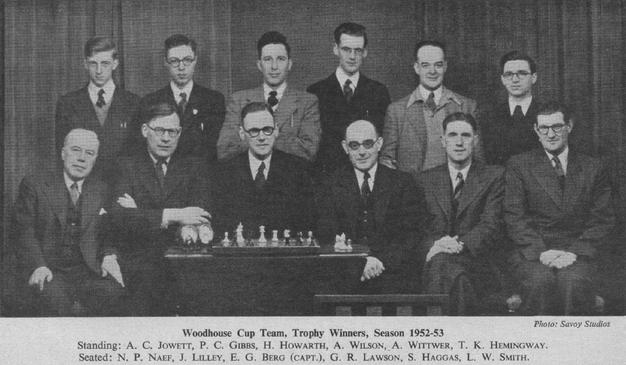
But where was the working man to be encouraged
to play chess? The Bradford club, with its 10s. entrance
fee and 10s. annual subscription, hardly offered him the opportunity
in those days. I have, been unable to discover how long
the Exchange Chess Club had been in existence before the amalgamation.
Its minute books have not been preserved, but it
must have had only a short life, for when, early in 1884, it applied
for membership of the West Yorkshire Chess Association its spokesman,
Mr. R. M. Macmaster, who
was also a member of the Bradford club, said he supposed that "every
player present knew that lately a new club had sprung up in Bradford". The youngster was full of vigour and self-assurance.
Mr. Mac-master claimed that although its history
had been short, it had been not altogether without brilliance, and
he declared that if the association refused it admittance, it had sufficient
confidence to challenge the association in a body. "Therefore," he added amid laughter,
"it might not be altogether impolitic in the association to allow
this enterprising club to be enrolled
within its ranks." The application, which was unanimously
approved, was seconded by a Leeds club representative, who said
that as the Exchange club had defeated the Leeds club, be did not
see how it could be kept out of the association.
That the Exchange club had every justification
for its confidence was shown by the results of the competitions
arranged between players attending the West Yorkshire Association
meeting that day. There were five classes, with eight
players in each of the first four and four in the fifth. The number
of prizes "won or divided by the successful competitors were,"
said the "Observer" report, "allotted among the various clubs
as follows: Bradford Exchange 4, Leeds 3, Wakefield 2, Dewsbury 2, and Sheffield L". Where was the Bradford Chess Club? When the youngster joined forces with
the 31-year-old club great things were expected and in due course
were achieved. A competition was arranged to ascertain the playing
strength of each member. In the classified list of members issued
in July, 1884, there were 30 in Class A, 32 in B, 38 in C, 19 in D and
26 in E—a total of 146, which is about twice the number of the club's
membership in this its centenary
year.
There were great days in store, with enthusiasm
in the club competitions and success in the Woodhouse
Cup, the Bradford club being the first winner of that trophy.
To celebrate the amalgamation a social
gathering of members and friends was held in July, 1884, and
on 20th February the following year there was a ball at the Technical
College. Chess had entered the social life of the town. And how
quickly a ball could be arranged in those days!
The committee appointed to make the arrangements
did not receive its final instructions until 13th February.
It had to work speedily, but with caution, for the minutes announce,
"The limit of the club's responsibilities to be £18".
The club must have been a very vigorous
organisation at that time, and the secretarial duties must
have been sufficient to require the services of two men, for the printed
circular inviting members to "the annual chess gathering"
to be held "on Saturday afternoon and evening, the 21st instant, when the
president's trophy, a handsome cup, will be competed for",
was signed by two honorary secretaries.
Unfortunately the two officials did not
keep the minutes so thoroughly as some of their predecessors
had done when it was a one-man task. The minutes of a few of
the committee meetings are entered in pencil. I have been unable
to discover an annual report for 1885, or any reference to the outstanding
achievement of being the first Woodhouse Cup winners; and the
only reference to the first annual ball after it had been held
is that "Mr. Starling read the report
of the ball and conversazione, showing a balance of £3 13s.
3d. to be handed over to the treasurer". Was that a profit, or was it what was
left out of the £18? |